Sunday, 20 March 2016
Wednesday, 17 February 2016
Interest Rates of Small Saving Schemes to be recalibrated w.e.f. 1.4.2016 on a Quarterly Basis
Interest Rates of Small Saving Schemes to be recalibrated w.e.f. 1.4.2016 on a Quarterly Basis to align the small saving interest rates with the market rates of the relevant Government securities;
Interest rate on savings schemes based on laudable Social Development or Social Security Goals including Sukanya Samriddhi Yojana, the Senior Citizen Savings Scheme and the Monthly Income Scheme left untouched by the Government.
The National Savings Schemes (NSSs) regulated by the Ministry of Finance offer complete security of investment combined with high attractive returns. These schemes also act as instruments of financial inclusion especially in the geographically inaccessible areas due to their implementation primarily through the Post Offices, which have reach far and wide.
The small savings interest rates are perceived to limit the banking sector’s ability to lower deposit rates in response to the monetary policy of the Reserve Bank of India. In the context of easing the transmission of the lower interest rates in the economy, the Government also has to take a comprehensive view on the social goals of certain National Small Savings Schemes. Accordingly, it has been decided that the following shall be implemented with effect from 1.4.2016 with regard to National Savings Schemes:
1. The Sukanya Samriddhi Yojana, the Senior Citizen Savings Scheme and the Monthly Income Scheme are savings schemes based on laudable social development or social security goals. Hence, the interest rate and spread that these schemes enjoy over the G-sec rate of comparable maturity viz., of 75 bps, 100 bps and 25 bps respectively have been left untouched by the Government.
2. Similarly the spread of 25 bps that long term instruments, such as the 5 yr Term Deposit, 5 year National Saving Certificates and Public Provident Fund (PPF) currently enjoy over G-Sec of comparable maturity, have been left untouched as these schemes are particularly relevant to the self-employed professional and salaried classes. This will encourage long term savings.
3. The 25 bps spread that 1 yr., 2yr. and 3 yr. term deposits, KVPs and 5 yr Recurring Deposits have over comparable tenure Government securities, shall stand removed w.e.f. April 1, 2016 to make them closer in interest rates to the similar instruments of the banking sector. This is expected to help the economy move to a lower overall interest rate regime eventually and thereby help all, particularly low-income and salaried classes.
4. The interest rates of all small saving schemes would be recalibrated w.e.f. 1.4.2016 on a quarterly basis as given under, to align the small saving interest rates with the market rates of the relevant Government securities;
Sr. No.
|
Quarter for which rate of interest would be effective
|
Date on which the revision would be notified
|
Rate of interest to be based on FIMMDA month end G-Sec. rate pertaining to
|
1.
|
April to June
|
15th March
|
Dec.-Jan.-Feb.
|
2.
|
July to September
|
15th June
|
Mar.-Apr.-May.
|
3.
|
October to December
|
15th September
|
Jun.-Jul.-Aug.
|
4.
|
January to March
|
15th December
|
Sep.-Oct.-Nov.
|
5. The compounding of interest which is biannual in the case of 10 yr National Saving Certificate (discontinued since 20-12-2015), 5 yr National Saving Certificate and Kisan Vikas Patra, shall be done on an annual basis from 1.4.16.
6. Premature closure of PPF accounts shall be permitted in genuine cases, such as cases of serious ailment, higher education of children etc,. This shall be permitted with a penalty of 1% reduction in interest payable on the whole deposit and only for the accounts having completed five years from the date of opening.
7. In pursuance to the decision as mentioned in Para 4 above, the rates of interest applicable on various small savings schemes for the quarter from April to June 2016 effective from 1.4.2016 would be notified in March, 2016.
The above changes have been brought with the objective of making the operation of National Saving Schemes market-oriented in the interest of overall economic growth of the country, even while protecting their social objectives and promoting long term savings.
Finance Ministry invites NJCA to discuss over 7th Pay commission recommendations on 19.2.2016
The Official Sources Close to the Finance Ministry told that a Meeting with National Joint Council of Action to be held on 19th February 2016 on the issues of 7th Pay Commission and Charter of Demands of NJCA.
It is informed that Convener, 7th Pay Commission Implementation Cell has fixed Meeting with NJCA on 19th February 2016 at North Block to discuss about the matters pertaining to 7th CPC recommendations and Charter of Demands of NJCA. The timing of the meeting scheduled itself has reveals its importance.
It is expected that, since the Meeting is scheduled before the Budget Session, some news about implementation of 7th pay commission may be announced in Budget or at least we are able to know the latest development about 7th cpc implementation after the Meeting.
An internal meeting of NJCA will also be held on 18.2.2015 before they attend the meeting with Finance Ministry.
Monday, 25 January 2016
Wednesday, 20 January 2016
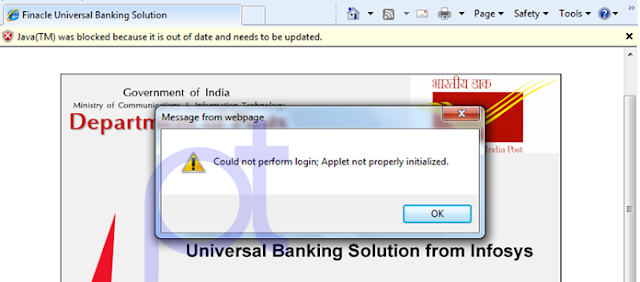
COULD NOT PERFORM LOGIN; APPLET NOT PROPERLY INITIALIZED IN DOP FINACLE
Java applet not properly initialized in Internet Explorer and could not perform login request in DOP finacle. The above issues are not related to Finacle Server it is a purely Finacle desktop configuration issues. Please check the Java settings for accessing Finacle Application.
Do the following to enable JAVA applet in IE Browser
Open Internet explorer
Tools-->Manage Add-ons
Under Oracle America, Inc following three options should be enabled.
1.Java(tm) Plug-In SSV Helper
2.Java(tm) Plug-In 2 SSV Helper
3.Sun Java Console
Saturday, 16 January 2016
ABOUT RURAL ICT FOR GRAMIN DAK SEWAKS
![]() |
| HAND HELD DEVICE |
- Electronic transactions- Booking and delivery of Speed Post, registered mail, money orders, sale of stamps and postal stationery will be done through these devices and paper receipt shall be generated
- instantaneously thereby eliminating chances of overcharging and other problems associated with manual transactions. Savings Bank deposits & withdrawals, PLI/RPLI premium deposits and loan/claim payments will also be done electronically on these devices.
- Immediate uploading of transaction data and financial reconciliation- Using mobile connectivity, data pertaining to all transactions done on the hand-held devices shall be uploaded onto the central server. E-Money order will reach the destination post office instantaneously unlike present day where the money order is digitized at the nearest computerized Post Office and leads to delay in delivery. All financial transactions shall also be reconciled immediately without any manual intervention and Cash on Delivery amount collected in the village shall be immediately credited to the account of e-Commerce Company. Similarly the artisans would be able to fulfill e-commerce orders and receive immediate payment for their sold products online. This will have a positive impact on the overall economy of the villages.
- Automatic track and trace- Speed Post and Registered letters/parcels and money remittances will be trackable at the Branch Post Office level and booking/delivery information will also be uploaded to central server immediately.
- Fraud and leakage elimination- As Savings Bank and Postal Life Insurance transactions will be done on a real-time basis and through immediate generation of receipt and voice message, chances of fraud would be eliminated. Biometric authentication of MNREGS and social security beneficiaries at the time of pay-out would also reduce leakage in the schemes
- Post Offices as Common Service Centres- Branch Post Offices shall be able to work as Common Service Centres and offer services such as Railway Reservation, online bill payment for electricity and water utilities, mobile and DTH recharge, insurance policy premium payments & transactions for partner banks/insurance companies/mutual funds etc
Saturday, 9 January 2016
ALL THE OFFICES WILL MIGRATE BY 2ND WEEK OF MARCH 2016 !!!
CBS Video Conference Dated 08.01.2016
Click the image to view the latest update on CBS rollout, installation of ATMs etc.
The Payment of Bonus (Amendment) Bill, 2015 notified:Increase in the Eligibility Limit under clause (13) of Section 2 and Calculation Ceiling under Section 12 of the Payment of Bonus Act, 2015
The Payment of Bonus (Amendment) Bill, 2015 was passed by the Parliament in the just concluded Winter Session of the Parliament. The Payment of Bonus (Amendment) Act, 2015 has been published in the Gazette of India, Extraordinary on 1st January, 2016 as Act No. 6 of 2016. The provisions of the Payment of Bonus (Amendment) Act, 2015 shall be deemed to have come into force on the 1st day of April, 2014.The Payment of Bonus (Amendment) Act, 2015 envisages enhancement of eligibility limit under section 2(13) from Rs.10,000/- per month to Rs.21,000/- per month and Calculation Ceiling under section 12 from Rs. 3500 to Rs.7000 or the minimum wage for the scheduled employment, as fixed by the appropriate Government, whichever is higher. The Payment of Bonus (Amendment) Act, 2015 also mandates previous publication of draft subordinate legislations, framed under the enabling provisions under the said Act, in the Official Gazette for inviting objections and suggestions before their final notification.
The Government has been receiving representations from trade unions for removal of all ceilings under the Payment of Bonus Act, 1965. It is also one of the demands made by them during the country-wide General Strike held in February, 2013 and September, 2015. As the last revision in these two ceilings were made in the year 2007 and was made effective from the 1st April, 2006, it was decided by the Government to make appropriate amendments to the Payment of Bonus Act, 1965.
These changes in the Payment of Bonus Act, 1965 will benefit thousands of work force.
The Government has been receiving representations from trade unions for removal of all ceilings under the Payment of Bonus Act, 1965. It is also one of the demands made by them during the country-wide General Strike held in February, 2013 and September, 2015. As the last revision in these two ceilings were made in the year 2007 and was made effective from the 1st April, 2006, it was decided by the Government to make appropriate amendments to the Payment of Bonus Act, 1965.
These changes in the Payment of Bonus Act, 1965 will benefit thousands of work force.
Friday, 1 January 2016
Thursday, 31 December 2015
Subscribe to:
Posts
(
Atom
)